Two months ago I was diagnosed with Crohn’s disease. I had gone in for a precautionary colonoscopy because I’d lost about 10 kg (22 lb) in a single month and felt the urge to go to the bathroom all day long—and the first thing that crossed my mind was colon cancer.
That annoying urge to go apparently has a medical name: the feeling of incomplete evacuation. It can be a symptom of irritable bowel syndrome, or IBS.
The road to a diagnosis
Getting a colonoscopy at all was a small miracle and a big stroke of luck. First I went to see a doctor, who ordered blood work and found out I had toxic levels of vitamin D.

That one is entirely on me, and I knew exactly what I was doing: on top of multivitamin tablets with 400% of the recommended daily dose, I was swallowing another 5,000 IU a day because Joe Rogan recommended it.
But the blood work also showed a high rheumatoid factor (in Czech)—RF 111.7—a level that points to ongoing inflammation in the body.

I immediately got a referral for a colonoscopy, and the fight for an appointment began. The doctor told me that if I managed to get anything within six months, I should grab it on the spot, because in England people wait up to a year for this exam.
The thought of a tumor growing in my gut while I’d have to wait six months to find out—because there was no chance anyone would stick a camera up my butt any sooner—did not thrill me at all.
So I tried calling every hospital in Brno I could think of, and begged friends and acquaintances to see if they could get me in somewhere.
In the end, out of pure desperation, I drove over to Gastroenterologie Zahradníkova (in Czech), a gastroenterology clinic in Brno, where they told me to come in the following Monday, because a woman who had been scheduled had just canceled at the last minute due to some illness.
Before that, though, I still had to fight it out with the nurse for a while. She had read in my referral that two weeks earlier I’d had a Barron ligation (rubber band ligation, a procedure to remove hemorrhoids), and she warned me the exam could hurt quite a bit.
In the end I talked her into booking me. I told her I’d survive, and that it surely wouldn’t hurt as much as the thrombosed external hemorrhoid I’d enjoyed sometime back in 2018, which they eventually had to cut open and clean out at the hospital.
The relief from the pain was amazing, but I also bled like a stuck pig. To this day I remember those blood-soaked pants going straight into the trash.
Thankfully I haven’t had an insanely painful external hemorrhoid like that since, but I regularly got the internal kind. It always started with blood on the toilet paper, followed by a visit to the proctologist—and even with the rubber band treatment, the little monsters came back about every six months.
But back to the colonoscopy. I got a prescription for a laxative, plus instructions on what to eat and, above all, what not to eat (fiber).
A week later I showed up for the exam, got a little something in my vein to make me loopy, and watched on the monitor what I look like on the inside. That alone is a fairly transcendental experience, and one I can warmly recommend.
One more side note: the exam didn’t hurt. At all. Not even a little. Maybe I’ve just gone numb after someone climbing up my butt every six months to suck a hemorrhoid into a tube and choke it off with a rubber band.
But when I read those crazy stories online about exams that had to be stopped because of the pain, I was shaking like a chihuahua. The reality was completely different—I felt practically nothing.
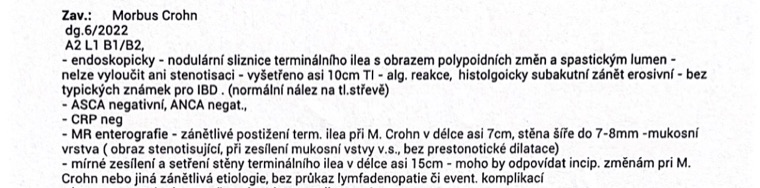
In any case, during the exam itself the doctor told me my colon was perfectly fine, but the end of my small intestine (about 15 cm, or 6 inches, of the ileum) was swollen and had some polyps.
I could actually see that on the monitor myself—including the moment she snipped off a piece of a polyp with forceps to send to the lab.
Thankfully the biopsy showed it wasn’t a tumor, but the MRI and ultrasound that followed confirmed Crohn’s disease.
Getting an MRI in any reasonable time was a tough nut to crack, too. The recommended clinic was booked solid until the end of the summer holidays, so I had to take a trip all the way to Šumperk, a small town in northern Moravia, where—thanks to a friend—they took me the very next week.
The ultrasound was a similar story: nothing available in Brno, so I set off for Nový Jičín, another town well over an hour’s drive away. What really touched me, though, was the nurse there. When I told her how I was driving all over the country to get the tests I needed, she said I was pushing it a bit too hard.
I do sometimes wonder whether it would have been better to just let things run their course: wait a year for the colonoscopy, then another few months for the other tests.
If I hadn’t pushed, I might have found out about Crohn’s a year and a half later. As it was, I had a confirmed diagnosis within a month of the first blood draw:
Blood tests
Colonoscopy
MRI
Ultrasound
Final diagnosis
It’s Crohn’s
The doctor told me it’s an idiopathic disease (meaning it arises from an unknown cause) that can’t be cured; treatment can only ease its course.
What an irony of fate, I thought. Me, of all people—someone who has been careful about what he eats for decades and cooks all his food at home from basic ingredients—and I get an incurable bowel disease.
Me, of all people—someone who has been careful about what he eats for decades and cooks all his food at home from basic ingredients—and I get an incurable bowel disease.
Treatment is basically built on corticosteroids, which can be supplemented with biologic therapy or immunosuppressants. And when none of that helps, surgery follows: the diseased section of the bowel is simply cut out, and on you go, for as long as there’s something left to cut.
Biologic therapy is supposedly the most effective, but also the most expensive, so it only gets started after all the “conventional” approaches have failed.
And when even surgery doesn’t help, all that’s left is artificial nutrition through a vein, because without the small intestine the body can’t process and absorb nutrients from food.
- Corticosteroids
The basis of the treatment.
- Biologic therapy or immunosuppressants
Can be added on top. Biologic therapy is supposedly the most effective, but also the most expensive, so it only gets started after all the “conventional” approaches have failed.
- Surgery
When none of that helps, the diseased section of the bowel is cut out.
- Artificial nutrition through a vein
When even surgery doesn’t help.
Right now I’m on a locally acting corticosteroid, Budenofalk (budesonide), which is supposed to reach the site of inflammation intact and gradually heal it. Every morning, half an hour before breakfast, I pour some hard little white pellets onto my tongue. You’re not allowed to chew them, just wash them down with water.
What to eat?
The biggest challenge, of course, is food. After losing so much weight I panicked and started stuffing myself with rice. I even tried bringing bread back into the game, but it always made me feel awful: bloating, pressure, insane noises in my belly, gas.
After the Crohn’s diagnosis I asked the doctor what I could eat, and I got a handbook from which I learned, in practice, only that it depends on what you can tolerate.
There are various approaches. Some restrict certain kinds of fruit and vegetables; others ban fatty foods and red meat.
And then there’s fiber. I had always believed fiber was a basic part of a healthy diet, and that eating it helped with good digestion and regular bowel movements.
So I was pretty taken aback when the doctor recommended I go on a low-residue diet. In other words, cut back on fiber.
I’d already gotten similar instructions while preparing for the colonoscopy. The nurse introduced them with this sentence: “This may sound strange to you, but for this week you have to cut out healthy food and eat a diet without fiber.”
That’s what brought me back to the idea of a meat-only diet. I had tried it for a few days several years ago, but quickly gave up after the diarrhea and the fear of not getting enough vitamins and fiber.
I couldn’t imagine a healthy body without vegetables, avocado and, above all, soluble and insoluble fiber that “cleans the gut of impurities.”
But now I’m in a situation where I don’t have much of a choice. I tried cheese, and afterward I thought my insides were going to burst.
Fruit and vegetables with fiber are off-limits for me now, partly thanks to the book The Fiber Menace. It may sound very radical, but it essentially blames fiber for almost every disease of the digestive tract, from hemorrhoids to Crohn’s to colon cancer.
Meat
My current diet is:
a) extremely simple and boring
b) relatively cheap (about 200 Czech crowns, or roughly $8, a day)
c) easy to digest
I eat only twice a day, at around 11 a.m. and 4 p.m. I found out I can’t handle three meals a day—they just make me feel sick. I started with beef steak, specifically rib-eye, but now I’m on ground beef with 20% fat from Tesco, the supermarket chain. I eat just under 750 g (about 1.6 lb) of it a day, plus 4 cooked egg yolks and a slice of roasted pork belly.
I tried dairy, specifically cheese, and it was a disaster. I decided to go the meat route, and so far it isn’t giving me any problems with bloating or digestion.
Of course, there are plenty of different and scary opinions aimed at people who decide, for whatever reason, to eat only meat:
- red meat causes colon cancer
- meat has no vitamin C
- meat has no minerals
- meat causes gout
- meat rots in your stomach
- meat has no fiber
It’s not my goal to debunk or explain anything here. So far the only thing I’ve noticed in myself is fatigue, but that may be down to the corticosteroids more than the meat.
Either way, right now I don’t have the courage for any experiments. I’m sticking with meat until it actually makes me sick.